
USATF OFFICIALS BEST PRACTICES Starter Preparations, Duties & Rules
Personal Equipment
| ∴Uniform prescribed for the meet | ∴Earplugs |
| ∴Red arm sleeve | ∴Whistle on lanyard |
| ∴Raingear | ∴Disqualification cards (red, yellow, green) |
| ∴Sunscreen & Sunglasses | ∴Rule book (applicable book) |
| ∴Hat (outdoors) | ∴Water, small washcloth |
| ∴.32 caliber pistol; 22 caliber (indoor) | ∴Pencil and 3×5 cards or small notebook |
| ∴.32/.22 caliber blank black powder shells | ∴Stepstool |
Duties
- Ensure starting blocks are set up within the competitor’s lane
- Start races promptly after athletes have been turned over to the starter by the clerk of the course
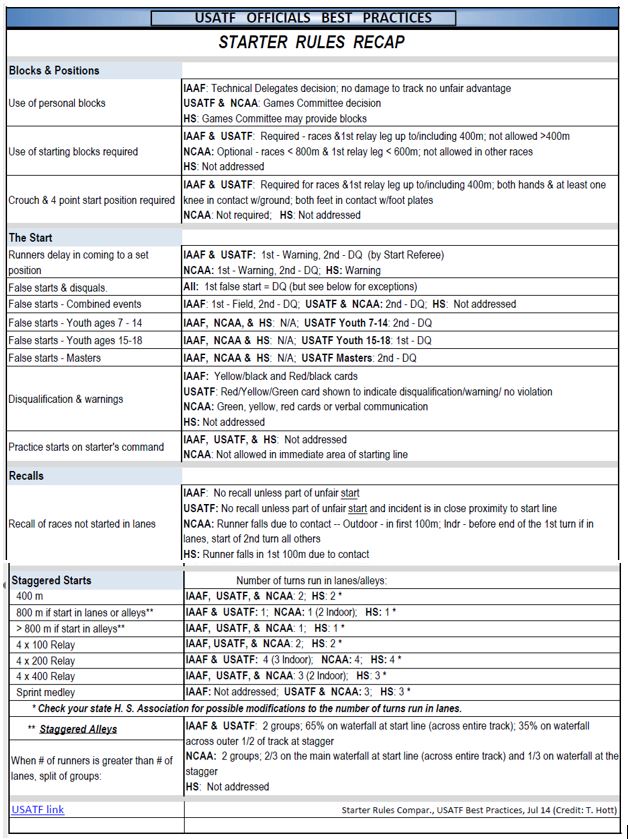
- Inform all competitors of warnings /or disqualifications through use of verbal communication and cards:
a) Green – no violation
b) Yellow (NCAA) – warning
c) Red (NCAA) – DQ
d) Red & Black (USATF) – DQ
- Be aware of rules for youth and masters athletes (302, 303, 332) – if applicable
- Signal by bell/pistol the start of the last lap of the race (high school)
Pre-Meet Preparations
- Arrive at least one hour early; attend officials meeting (if scheduled)
- Walk the track – be familiar with start/finish lines, exchange zones, location(s) for starter/recall starter, electronic equipment location(s), safety concerns, condition of blocks
- Check with Meet Director and Referee – verify meet schedule, any specific equipment to be used (personal blocks, headphones/radio communication systems, etc.)
- Check with Clerk of the Course – review schedule, review clerk/starter instructions so no overlap
- Check with Head Finish Judge – verify signals between starter/finish judges (if any)
- Check with timing personnel – check all equipment, verify equipment locations, verify signals between starter & timer
- Check with Announcer & Clerk to synchronize watches for time schedule of meet, and timing of PA announcements in regard to reporting & race starts
- Meet with Starter crew – walk the track, review schedule of duties, positions (straight-aways & turns), hand signals, synchronize watches, assign positions
- Meet with television reps (if applicable) regarding timing, schedule; make necessary accommodations
Starts
- Positioning
- Races started in lanes on the curve (staggered) – be equidistant from all runners – approx. 20 meters inside the curve, opposite middlelane start line. (Note: if a Starter stands 25 meters away from lane 1 and 70 meters away from lane 8 when the gun is fired for a 400m race, Lane 1 will hear the sound in .08 seconds; Lane 8 will hear it in .21 seconds, a difference of .13 second). (Recall starters, if used, are placed as assigned by the head starter to clearly see each competitor.)
- Races started on a straightaway or waterfall – be approx. 4 meters in front of the start line and 5 meters to the inside, to allow sight of all runners in a narrow field of view. (Recall starters, if used, are placed at the opposite end of the start line.)
- Starting blocks:
- NCAA < 500 m – crouch w/ or w/out blocks
>5000 m standing at “step-up” line;
- USATF ≤ 400m (open & relays) must use blocks
>400m standing at “step-up” line
- NCAA < 500 m – crouch w/ or w/out blocks
- Practice starts may not be made in conjunction with start commands and the gun – NCAA
- After athletes are on their marks, give the command to “stand up” if all is not ready to proceed
- If there are multiple starters, confer regarding any apparent false starts
- Recall starts in the event of an unfair start, or upon hearing a false start acoustic signal. Recall starts for falls by athletes when: USATF – a fall is associated with, and within 10 meters of the start; NCAA – a fall occurs because of contact with another runner in the first 100 meters.
Safety Considerations
- Always look before you step onto the track; sprinters warming up – watch before stepping into another lane as sprinters are getting blocks set
- Throwing & jumping events – be aware of athletes beginning their approach/run-up (particularly indoors); coordinate with head officials of those events regarding your starts.
Download/print Starter information
 Texas A&M Track and Field Officials Association